
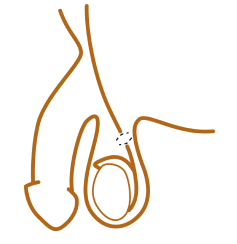
What is a vasectomy reversal?
A vasectomy is a form of contraception for men that stops sperm from being carried in the semen. It is a very popular operation, but some men later decide they would like it reversed.
Circumstances can change, and a vasectomy may no longer suit your needs. After a vasectomy, sperm no longer leaves the body on ejaculation, but the testicles keep producing sperm, which is why a reversal may be possible.
Vasectomies are intended to be permanent, yet they can often be reversed, and a small but significant number of men choose to do so. Whether you have remarried or simply changed your mind, the specialists at London Andrology can help restore your fertility with a vasectomy reversal.
Preparation for a vasectomy reversal
Men choose a vasectomy reversal for many reasons. Whatever the reason, you will first talk through the possibility of the procedure with your doctor and have an examination.
It is important to know that a vasectomy reversal can be a much more involved operation than the original vasectomy, because the surgeon has to repair the tubes that were cut and sealed the first time.
Your doctor will examine you to check you are well enough for surgery, and will also need to confirm that you can produce healthy sperm before operating. Some doctors will also want to know whether your partner is able to have children before going ahead.
Vasectomy reversal procedure
A vasectomy reversal is carried out under general anaesthetic and can take up to three hours. By contrast, a vasectomy is done under local anaesthetic and can take as little as 15 minutes, which shows how much more complex the reversal is.
The surgeon makes incisions in the scrotum and rejoins the vas deferens, working under a microscope. Once the tubes are reconnected, they are stitched together.
During the same operation, sperm is taken directly from the testicles and frozen, so there is a backup supply if the reversal does not succeed. This frozen sperm can be used for ICSI.
Recovery from a vasectomy reversal
Recovery can take some time. You will need at least a week off work while the discomfort settles, and it is best to wait a month before having sex again.
Having intercourse too soon can stop the tubes from healing fully. Over-the-counter painkillers can help with pain after surgery, and applying ice to the area can reduce swelling and discomfort.
Related treatments and conditions
Research from our team
- Research paper 01Varicocele Treatment in Azoospermia Before Artificial Reproductive Techniques: Critical Considerations by the EAU Guidelines Panel on Sexual and Reproductive Health.Read article ↗
- Research paper 02Definition of a European pre-vasectomy scoring system to identify patients at risk of vasectomy regret.Read article ↗
- Research paper 03Oncological microdissection testicular sperm extraction (Onco-microTESE) outcomes for fertility preservation of patients with testicular cancer with azoospermia or severe oligoasthenoteratozoospermia.Read article ↗
- Research paper 04Does hormonal therapy improve sperm retrieval rates in men with non-obstructive azoospermia: a systematic review and meta-analysisRead article ↗
- Research paper 05Sperm recovery and ICSI outcomes in men with non-obstructive azoospermia: a systematic review and meta-analysisRead article ↗