
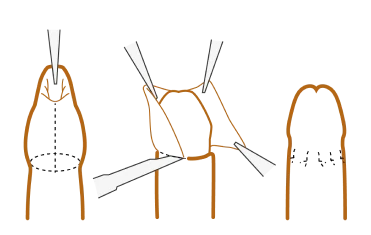
Why have a circumcision?
There are several reasons a man might have a circumcision. Medical reasons include a tight foreskin (phimosis), recurrent balanitis, paraphimosis and a number of other conditions. Most circumcisions are carried out because of phimosis.
Choosing to have a circumcision is a very personal decision, and the right urologist can make all the difference to how you feel about this routine procedure.
The foreskin is usually removed in childhood, but many men decide to wait until adulthood. Adults choose circumcision for many reasons, including:
- Religion
- Appearance
- Hygiene
- Medical reasons
Circumcision procedure
Circumcision is usually done as a day case, so you are admitted, have the operation and go home on the same day.
You will be asked not to eat or drink for six hours before surgery, particularly if you are having a general anaesthetic. When you arrive at the clinic, you will be looked after by the medical team carrying out the procedure, and you will talk it through with the surgeon and the anaesthetist. This is a good time to raise any concerns and ask any questions.
Recovery from circumcision
After the operation, you will be looked after until you are discharged. Before you leave, you will be given advice on recovering at home, including driving, returning to work and sex. Recovery takes around ten days on average, and we recommend taking a week off work.
Unlike some procedures, you do not need to tell the DVLA if you have had a routine circumcision and have no other medical conditions that could affect your driving. It is up to you to decide when you are fit to drive, and you should avoid sexual intercourse for at least four weeks after the operation.
For three to four days after surgery, you are likely to have some discomfort and swelling around the head of the penis, and you will be given painkillers to help.
Related treatments and conditions


Research from our team
- Research paper 01Evaluating the appropriateness of penile prosthesis in non-organic erectile dysfunction and premature ejaculation: a Delphi consensus among penile implant surgeons.Read article ↗
- Research paper 02Penile prosthesis implantation: a systematic review of intraoperative and postoperative complications.Read article ↗
- Research paper 03Long-term penile prosthesis couple's satisfaction: A systematic review and meta-analysisRead article ↗
- Research paper 04Publisher Correction: Penile implants in low flow priapismRead article ↗
- Research paper 05Penile implants in low flow priapismRead article ↗
- Research paper 06European Association of Urology Guidelines on Penile Size Abnormalities and Dysmorphophobia: Summary of the 2023 GuidelinesRead article ↗